

Colorado has two winter driving laws. The Traction Law means your tires must have at least 3/16 inch of tread and be winter, all-weather, or M+S rated, or else you need chains or a traction device. That applies to every car, even all-wheel and four-wheel drive. The Chain Law means every car needs chains or an approved device, no exceptions.
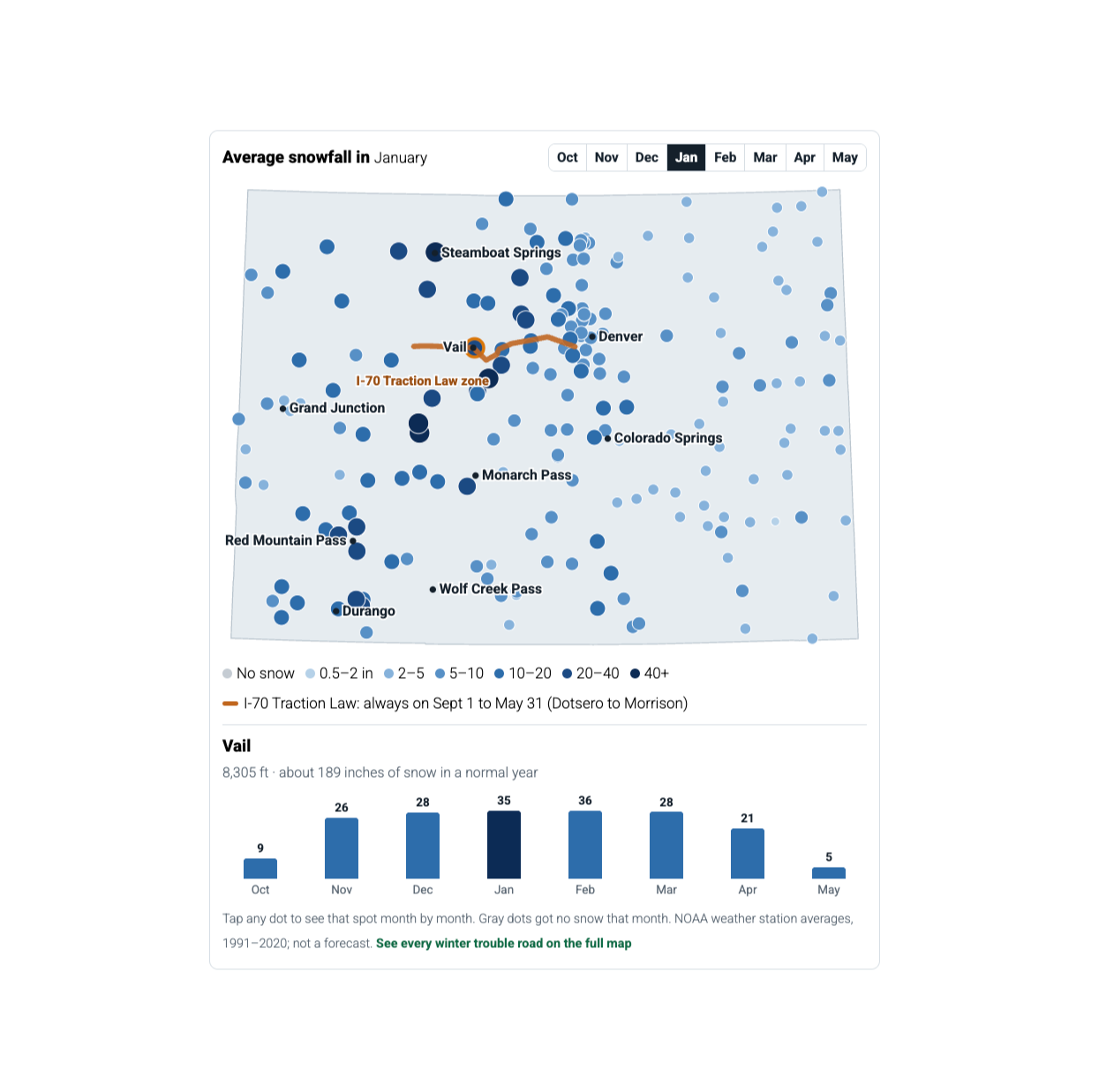
The map shows where Colorado gets the most snow each month. The orange line is the stretch of I-70 where the Traction Law is on all season.

Alice’s Pick
One weekend in Glenwood Springs will ruin regular vacations for you
Soak in steaming hot springs while snow falls on the mountains around you. Then go back the next morning and do it again.
Average snowfall in January
Tap any dot to see that spot month by month. Gray dots got no snow that month. NOAA weather station averages, 1991–2020; not a forecast. See every winter trouble road on the full map
What is the Colorado Traction Law?
The Traction Law, also called Code 15, sets the minimum gear you need to drive a Colorado highway in winter. As of fall 2025, it covers every passenger vehicle, whatever the drivetrain.
To drive when it’s on, your car needs one of these:
- Winter tires with the mountain-snowflake symbol and at least 3/16 inch of tread
- All-weather rated tires with at least 3/16 inch of tread
- Mud and snow (M+S) tires with at least 3/16 inch of tread
- Chains or an approved traction device, like an AutoSock, on two or more drive tires
The big change: four-wheel drive or all-wheel drive alone is no longer enough. Your tires have to meet the rule too.
When is the Colorado Traction Law in effect?
- On I-70, always, from September 1 to May 31, between Dotsero (west of Vail) and Morrison (west of Denver). That’s the orange line on the map. You don’t wait for a storm. If you’re on that stretch in those months, the law applies.
- On any other state highway, whenever CDOT turns it on for a storm.
- How you’ll know: road signs and CDOT alerts. You can sign up for CDOT’s text and email alerts, or check COtrip.org before you leave.
What is the Colorado Chain Law?
The Chain Law, also called Code 16, is the last step before CDOT closes a road. When it’s on:
- Every passenger vehicle needs chains or an approved traction device installed on two or more drive tires.
- Good tires and four-wheel drive don’t get you out of it.
- It can start any time the weather is severe, usually on steep mountain grades.
- Driving a closed road, or driving during a restriction without the right gear, is against the law.
Do you need chains in Colorado with all-wheel drive?
Not for the Traction Law, if your tires meet the rule. You do need them for the Chain Law.
- AWD or 4WD with good tires (3/16 inch of tread, and M+S, all-weather, or winter rated): you meet the Traction Law.
- AWD or 4WD with worn or summer tires: you don’t. You need chains or a traction device.
- Front-wheel or two-wheel drive: FOX31 reports these cars need chains or traction devices for at least two tires when the law is active. Carrying an AutoSock or chains on I-70 is the safe move.
- When the Chain Law is on, everyone needs them.
How do you check your tires for the Colorado Traction Law?
- Look at the sidewall for “M+S,” “M/S,” or the mountain-snowflake symbol.
- Check the tread depth. You need at least 3/16 inch. A cheap tread depth gauge from any auto parts store gives you an exact answer.
- Check all four tires, not just the front ones.
Does the Colorado Traction Law apply to rental cars?
Yes. The law covers every passenger vehicle, rentals included.
- Check the tires before you leave the rental lot, using the steps above.
- Many rental contracts don’t allow chains. Read yours before you plan on using them.
- Ask for a vehicle with all-weather or snow-rated tires if you’re heading into the mountains.
Is the chain law in effect on I-70 today?
The Traction Law is always on for I-70 between Dotsero and Morrison from September 1 to May 31, so the answer is yes for that whole season. The Chain Law changes storm by storm.
- Check COtrip.org, CDOT’s road conditions site, the morning you leave.
- Sign up for CDOT’s text and email alerts for road conditions, closures, and chain laws.
- Watch the road signs. The Chains Required sign means stop and chain up before you go on.
Which Colorado roads are hardest in winter?
Each of these is on our Winter Road Trouble Map with a safer option and a town to wait out a storm.
- I-70 over Vail Pass and through the Eisenhower Tunnel: the main route across the Rockies, with frequent closures. Wait it out in Denver, Silverthorne, or Glenwood Springs.
- US-6 over Loveland Pass: use I-70 through the Eisenhower Tunnel instead. Wait it out in Georgetown or Silverthorne.
- US-50 over Monarch Pass: wait it out in Salida or Gunnison.
- US-160 over Wolf Creek Pass: wait it out in Pagosa Springs or South Fork.
- US-550 over Red Mountain Pass: steep, with sheer drop-offs and no guardrails in spots. CO-62 and CO-145 over Lizard Head Pass is a longer, gentler way around. Wait it out in Ouray or Durango.
- I-25 over Monument Hill: between Denver and Colorado Springs. Wait it out in Castle Rock or Colorado Springs.
- Closed all winter: Trail Ridge Road, Independence Pass, Cottonwood Pass, Kebler Pass, Guanella Pass, and the Mount Blue Sky road.
How much snow does Colorado get?
In a normal year, based on NOAA’s 1991–2020 averages:
- Winter Park: about 214 inches
- Vail: about 189 inches
- Breckenridge: about 185 inches
- Steamboat Springs: about 184 inches
- Silverton: about 173 inches
- Aspen: about 171 inches
- Denver: about 40 to 50 inches, which often melts within days
The mountains get snow from October into May. January through March are the heaviest months in most ski towns.
FAQ
The Traction Law lets you drive with good tires: at least 3/16 inch of tread and winter, all-weather, or M+S rated. The Chain Law is stricter. Every vehicle needs chains or an approved traction device, no matter the tires or drivetrain.
On I-70 between Dotsero and Morrison, it runs every year from September 1 through May 31. On other state highways, CDOT turns it on during storms.
Not by itself anymore. Since fall 2025, AWD and 4WD vehicles also need tires with at least 3/16 inch of tread that are winter, all-weather, or M+S rated.
You need good tires all season. If your tires don’t meet the Traction Law, you need chains or a traction device. When the Chain Law is on, every vehicle needs them.
Yes. CDOT accepts approved alternative traction devices like AutoSocks in place of chains under both the Traction Law and the Chain Law.
Check COtrip.org, sign up for CDOT’s text and email alerts, and watch for road signs. The Traction Law on I-70 is always on from September 1 to May 31.
Plan your Colorado winter drive
Check your tires before you leave home, carry chains or an AutoSock, and look at COtrip.org the morning you drive. For every winter road that closes across the country, see our Winter Road Trouble Map. If you get caught in a storm, our car emergency kit guide covers what to keep in the car.
Please read: We researched Colorado’s laws and roads and put it all in one place to help you plan. Laws change, and we may have missed something or gotten something wrong. Snow totals are NOAA’s 1991–2020 averages, not a forecast. Always check CDOT’s current rules and road conditions before you go, and follow posted signs and closures. Road Trip Owl isn’t responsible for travel decisions made using this article.
About the author
Hi, I’m Alice. I’ve been running Road Trip Owl since 2021 and taking 6+ multi-day road trips a year. I live in northern Michigan, so I can drive in snow. Colorado mountain passes, chain laws, and tire rules are a different story. I’m planning my own winter drive out West, so I dug into CDOT’s rules and 30 years of NOAA snow data to get it straight for my own trip.