

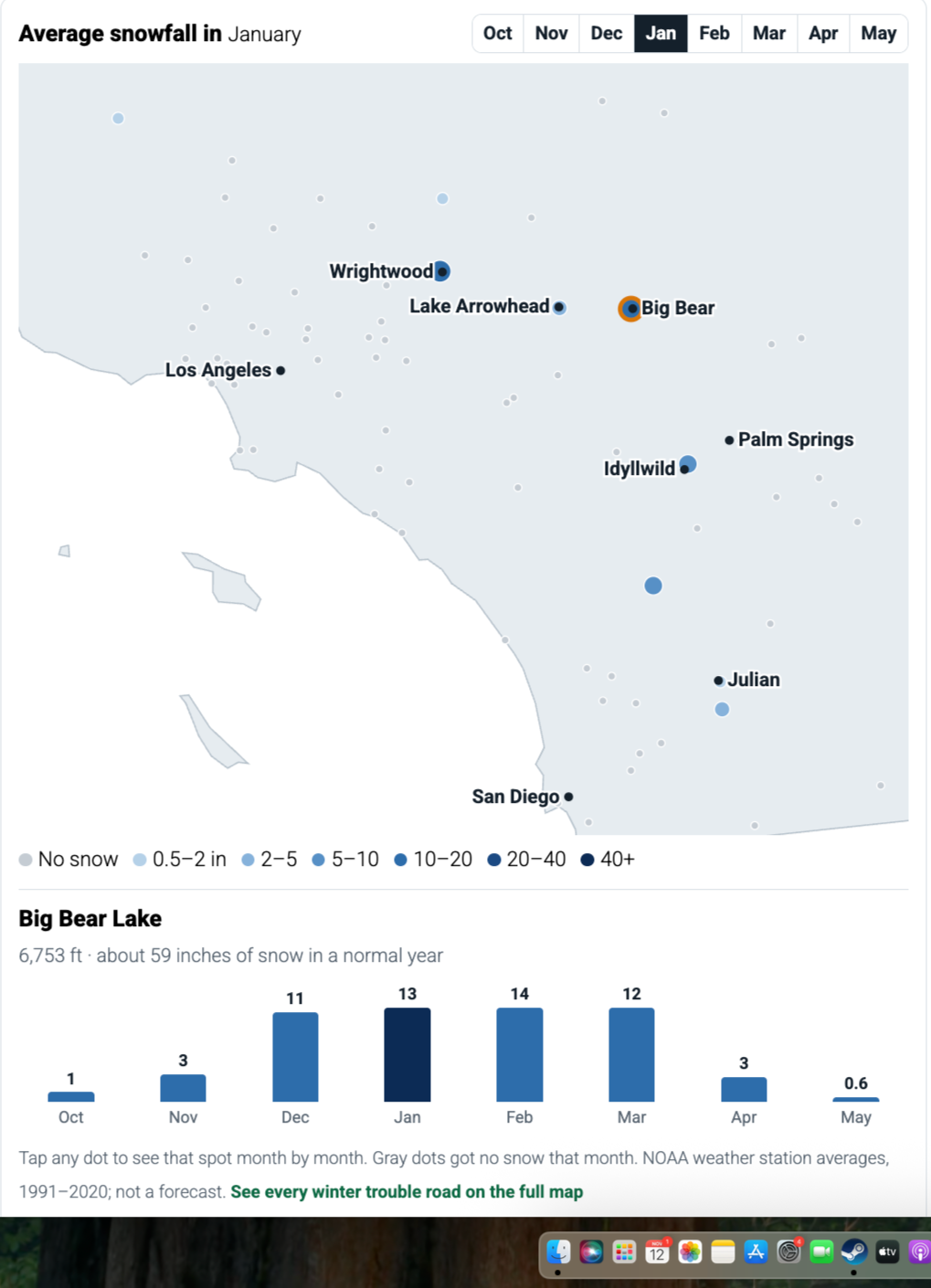
Big Bear gets most of its snow from December through March. Each of those months averages 11 to 14 inches, and February is the snowiest. Snow can start in October and hang on into April, but expect only a few inches in those months. In a normal year, Big Bear Lake gets about 59 inches of snow.
Tap any dot on the map to see how much snow that mountain town gets each month. The numbers are NOAA’s 30-year weather station averages (1991 to 2020).
Alice’s Pick
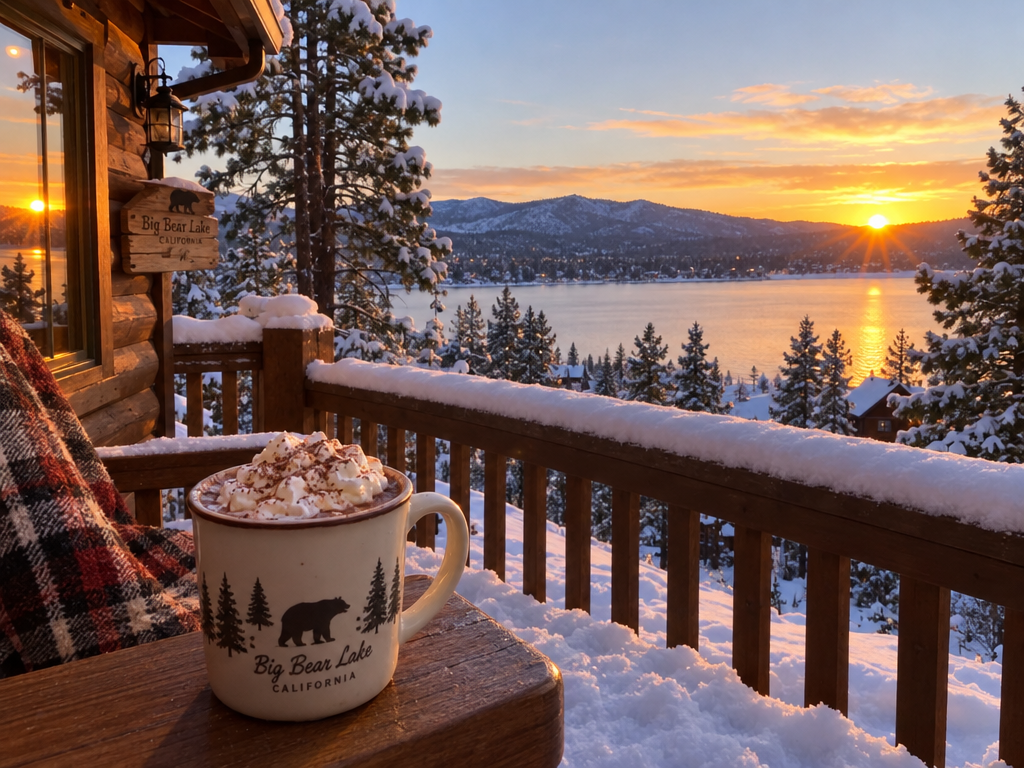
Wake up to snow in a Big Bear cabin
Fireplace, hot cocoa, and snow outside the window. December through March is your best bet.
Average snowfall in January
Tap any dot to see that spot month by month. Gray dots got no snow that month. NOAA weather station averages, 1991–2020; not a forecast. See every winter trouble road on the full map
How much does it snow in Big Bear each month?
Here’s a normal year at Big Bear Lake, 6,753 feet up:
- October: about 1 inch. An early dusting at most.
- November: about 3 inches. The first real snow usually shows up late in the month.
- December: about 11 inches. Snow season is on.
- January: about 13 inches.
- February: about 14 inches, the snowiest month.
- March: about 12 inches. Spring storms can still bury the town.
- April: about 3 inches. Snow is winding down.
- May: under an inch. It’s rare.
For the best shot at snow on the ground, plan your trip for January or February.
When is the best time to see snow in Big Bear?
- Best odds: mid-December through early March. That’s when storms are most frequent and snow sticks around between them.
- Holiday trips: late December is a good bet, but not a promise. December averages about 11 inches, and some years start slow.
- Spring trips: March averages almost as much snow as January, with fewer crowds than the holidays.
- Right after a storm is when Big Bear looks its best. It’s also when the roads are busiest and chain controls are most likely.
A normal year is just an average. Some winters bring far more, some far less. Check the forecast a few days before you go.
Do you need chains to drive to Big Bear?
You need to carry chains, and during storms you may need to put them on.
- Carry them all season: Visit Big Bear says all drivers are required to carry tire chains or cables from November 1 through April 25. Caltrans can check during storms.
- R1: chains or snow tires required. Most cars with snow tires keep going.
- R2: chains required on most cars. Highways 18 and 38 go to R2 during storms. Four-wheel drive or all-wheel drive with snow-tread tires on all four wheels can usually pass without them, but must still carry chains.
- R3: chains on everyone. In practice, the road usually closes instead.
- It happens: in February 2026, drivers got stranded on icy roads around Big Bear when chain controls went up.
- Rental cars: many rental contracts don’t allow chains. Check yours before you drive up.
How many snow chains do you need for Big Bear?
Chains come in sets that cover two tires, one axle.
- Front-wheel drive: one set on the front tires.
- Rear-wheel drive: one set on the back tires.
- All-wheel or four-wheel drive: usually one set on one axle, but check your owner’s manual for which one.
- Practice at home first. Putting chains on for the first time on a cold, snowy shoulder is miserable. A dry run in your driveway makes the real thing fast.
What’s the easiest road to Big Bear in snow?
There are four main ways up the mountain. Here’s how Visit Big Bear describes them:
- Highway 330 from Highland: the most popular route.
- Highway 38 from Redlands: the most comfortable drive.
- Highway 18 from Lucerne Valley: the back way, and the quickest climb.
- Highway 18 through Waterman Canyon: the most scenic, and not recommended in snow.
Before you leave, check Caltrans QuickMap for chain controls and closures, and pick your route from there. If the roads close behind a storm, wait it out in San Bernardino or Redlands, not on the shoulder.
Where else can you see snow near Big Bear?
Big Bear gets the most reliable snow in Southern California, but it’s not the only snowy town:
- Wrightwood: about 62 inches a year, a bit more than Big Bear. February is its big month, with about 25 inches.
- Idyllwild: about 31 inches, in the mountains above Palm Springs.
- Palomar Mountain: about 26 inches, the snowiest spot in San Diego County.
- Lake Arrowhead: about 22 inches, on the way up to Big Bear.
- Cuyamaca: about 20 inches, east of San Diego.
- Julian: about 6 inches. San Diego’s best-known snow town, but it doesn’t snow there every year.
FAQ
February. Big Bear Lake averages about 14 inches of snow in February. January and March are close behind, at about 13 and 12 inches. December averages about 11.
Sometimes. Big Bear averages about 3 inches of snow in November, usually late in the month. It’s not reliable. For a trip with snow on the ground, December through March are much better bets.
Usually. December averages about 11 inches at Big Bear Lake. Some Decembers start slow, so check the forecast before a holiday trip.
You need to carry them. All drivers must carry chains or cables from November 1 through April 25. During storms, Highways 18 and 38 can go to R2, which means chains on most cars unless you have four-wheel or all-wheel drive with snow tires.
About 59 inches in a normal year at Big Bear Lake, based on NOAA’s 1991–2020 averages. Most of it falls from December through March.
Big Bear. It sits about 1,500 feet higher and averages about 59 inches of snow a year, compared to about 22 at Lake Arrowhead.
Plan your snow trip
Pick a weekend from January through March for the best odds, carry chains, and check Caltrans before you head up. For the rest of the state, see our Does It Snow in California? guide. For every winter road that closes or needs chains, see our Winter Road Trouble Map.
Please read: Snow totals here are NOAA’s 1991–2020 averages from weather stations. They show what a normal year looks like, not what this winter will bring. We researched the roads and rules in this article and put them in one place to help you plan, but we may have missed something or gotten something wrong, and conditions change with every storm. Always check current road conditions and follow posted signs, chain controls, and closures. Road Trip Owl isn’t responsible for travel decisions made using this article.
About the author
Hi, I’m Alice. I’ve been running Road Trip Owl since 2021 and taking 6+ multi-day road trips a year. I live in northern Michigan, so snow is normal life for me. Mountain roads and chain rules are not. I’m planning my own winter drive out West, so I dug into 30 years of NOAA snow data and the road rules to answer the questions I had myself.