

The Best Clean Sunscreen I’ve Found (Plus the Clean After-Sun That Actually Works)
What I Use (Quick Picks)
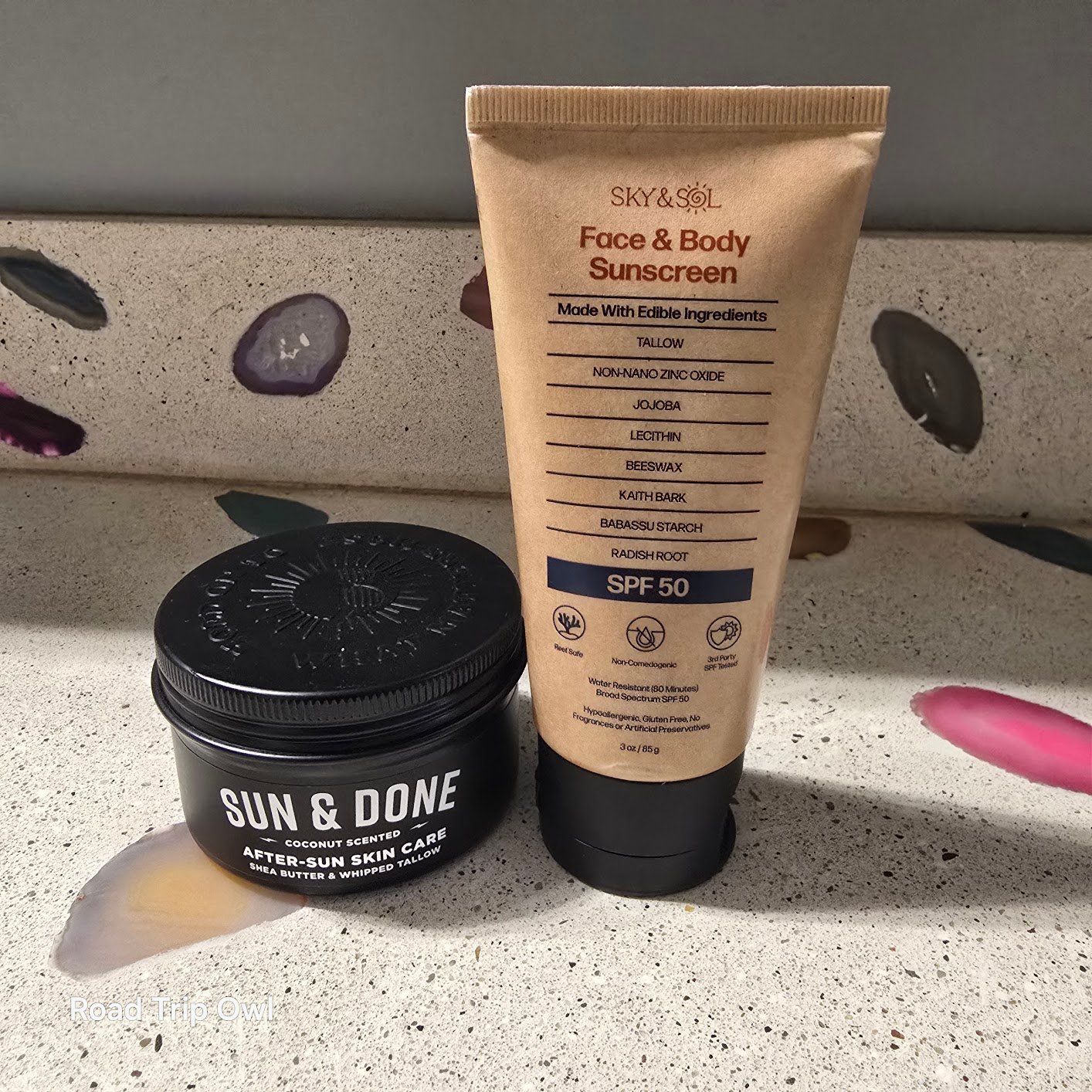
- For sun protection: Sky and Sol Mineral Sunscreen SPF 50 — clean, tallow-based, no white cast, water-resistant for 80 minutes
- For after sun: Pilotfish Sun & Done — clean, simple ingredients, sensitive-skin approved, applies every other day instead of every 20 minutes
- For really bad burns: vitamin E pills. Yes, just regular vitamin E pills. They live in my suitcase forever now. (You’ll see why.)
One thing to watch when you buy the vitamin E:
The one I use is NOW Foods Sun-E 400 IU from non-GMO sunflower oil — soy-free, third-party tested, and the actual natural d-alpha form. If you’re stocking your suitcase too, look for that one or one like it. Specifically look at the ingredient label and check for the “d-” prefix without the “L” — that’s the give-away.
Full reviews below — plus the honest backup if you can’t go fully clean yet, and the rabbit hole I went down on why I keep burning in the fall.
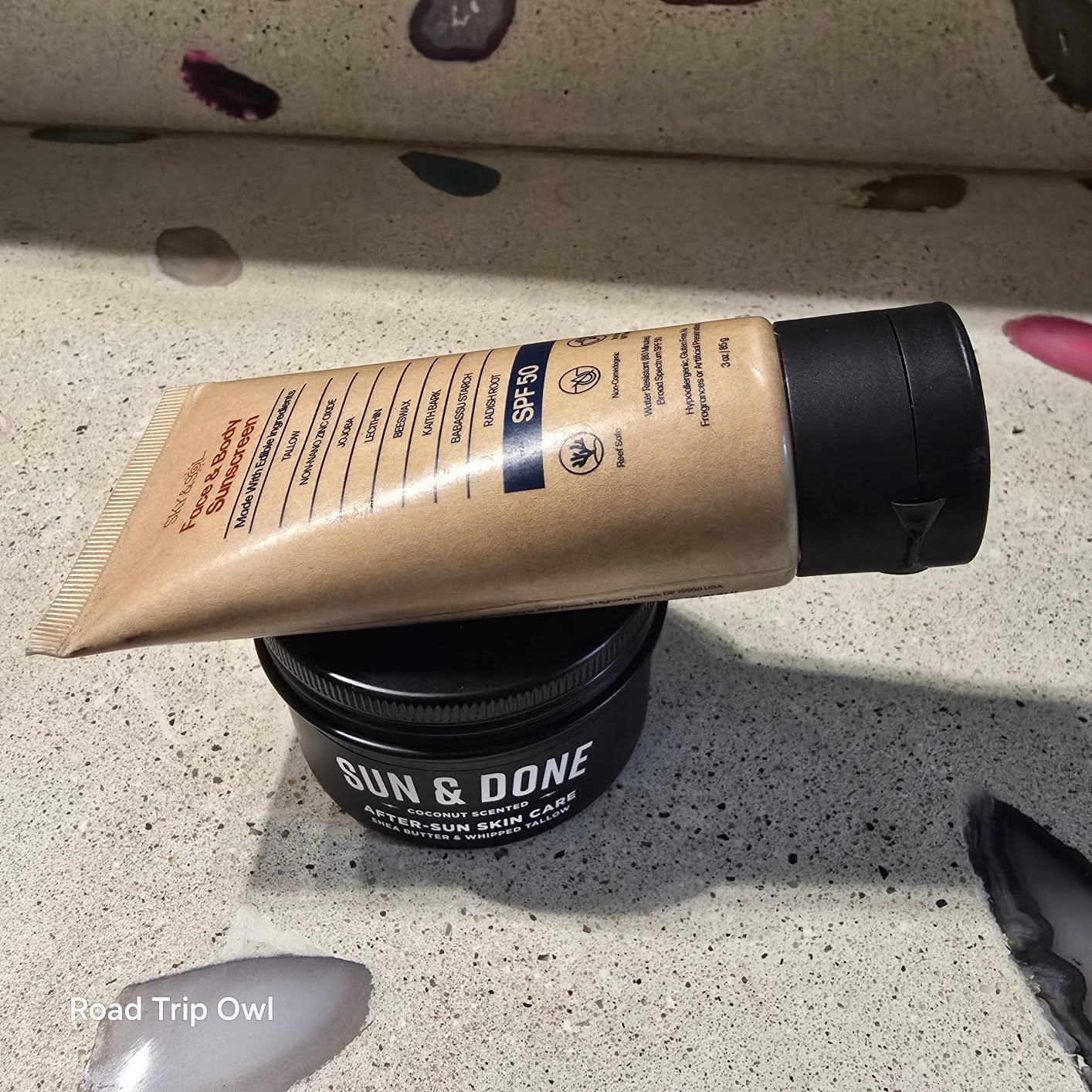
The Clean Sun Care I Actually Use (And Why I Stopped Looking)
Here’s the deal: I work outside. Daily sun exposure, every season. And for years I refused to use regular sunscreen — not because I was lazy or didn’t believe in protection, but because I wasn’t about to slather chemicals on my skin and then go bake them in for eight hours.
I’d rather burn than put chemicals on my skin. That was my stance.
So I burned. Every spring. Every fall. (And yes — something happens in the fall that brings the burn right back around. I finally looked into it, and turns out there’s an actual reason. More on that in a minute.)
For the record, I’m dark-skinned and I still burn just sitting in the sun. There is no “sunbathing” for me. I burn.
I kept thinking there had to be a clean sunscreen out there that actually works. So every once in a while, I’d look. And every once in a while, I’d come up empty.
Then my sister handed me a bottle at a festival and said “try this.” She’s also trying to live cleaner, so we kind of compare notes — and that’s how I found Sky and Sol. (Reviewed below.)
A little later I realized something kind of embarrassing: I was undoing the whole thing. I’d put my clean sunscreen on for the big-burn days, but every other day I was still getting a little red — and reaching for chemical after-sun lotion to fix it. If I’m avoiding chemicals on healthy skin under the sun, why was I rubbing chemicals into my already-damaged skin to heal it? That made no sense.
So a second search started, this time for clean after-sun. Eventually I found Pilotfish. (Also reviewed below.)
Both products work so well that I haven’t gone looking for alternatives since. And honestly? I’m someone who ALWAYS looks around. The fact that I stopped looking is kind of the whole review.
This article is for the people who are in the same place I was: tired of chemical sunscreens, frustrated with “clean” brands that aren’t actually clean, and ready for something that actually works.
Wait, Why Do I Keep Burning in the Fall?
Quick detour, because I always assumed fall was the “safe” season. Cooler weather, lower sun angle, summer tan in place — what could go wrong? Apparently a lot.
I looked it up. Turns out there’s a real reason fall burns happen (and it’s not just me being weird about it):
Your skin barrier is weaker in fall. Lower humidity, indoor heat starting back up, hotter showers — all of that strips the natural oils that help your skin defend itself. Dry skin is way more vulnerable to UV damage than hydrated skin.
UV rays don’t take fall off. UVB rays (the ones that burn) are slightly weaker, but UVA rays (the ones responsible for aging and skin cancer) stay strong year-round. And the sun’s angle can still deliver real radiation even when the air feels cool.
Clouds don’t save you. Up to 80% of UV rays pass through clouds. Those gray autumn days are doing damage too.
A summer tan is barely SPF 3. That base tan you spent all summer building offers maybe SPF 3 or 4 worth of actual protection. Functionally nothing.
So I’m not crazy — fall burns are real. Now I know to actually pull the sunscreen out in autumn, instead of assuming the cool air means I’m safe.
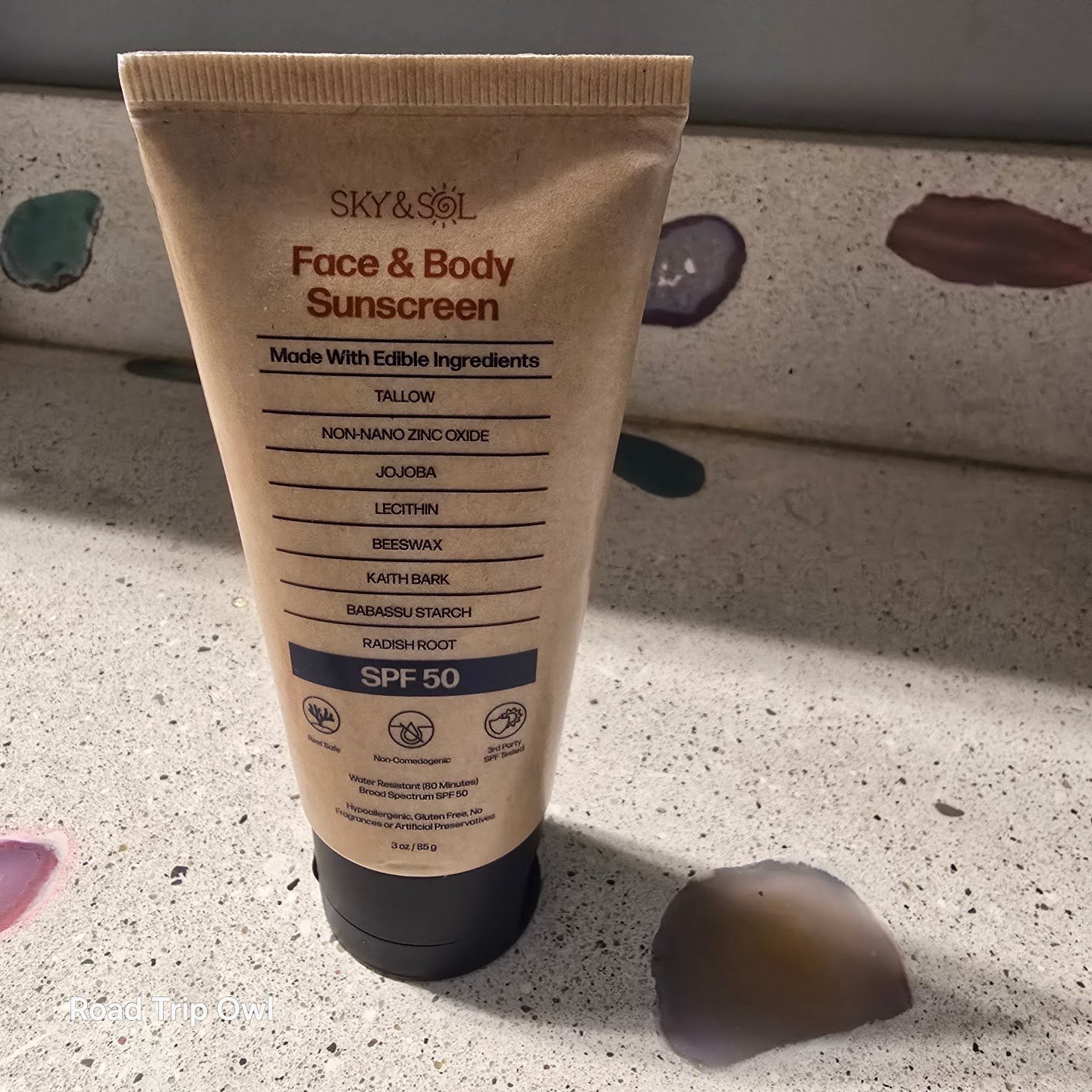
Sky and Sol Mineral Sunscreen SPF 50
This is the bottle my sister handed me at that festival. And it turned out to be the first sunscreen I’d seen in years that actually passed every check I cared about.
Why this one passes:
The active ingredient is non-nano zinc oxide — a physical mineral that sits on top of your skin and reflects UV rays instead of soaking in and reacting the way chemical filters do. No Octinoxate, no Oxybenzone, no synthetic UV chemicals.
The base is edible-grade organic tallow — which sounds weird if you’re not in the natural skincare world, but tallow is one of the most skin-compatible fats there is. It matches your skin’s own natural oils, which is why this stuff goes on non-greasy, absorbs without a white cast, and doesn’t break me out (and my face breaks out at the slightest provocation).
It’s reef-safe, fragrance-free, and free of the seed oils, preservatives, and silicones most sunscreens hide in their ingredient lists.
It’s SPF 50 and water-resistant for 80 minutes per the brand’s testing. I’ve worn it in the pool and it seemed to hold up even longer than that on me — but I’ll go by their research, not my pool day.

The festival test:
I took it to a 3-day festival south of where I live. It was so hot that people were buying 7-pound bags of ice and sitting with them on their laps just to cool down. Three full days, hotter and sunnier than what I’m used to up north. I’m dark-skinned but I burn easily — and I did not burn. Not even a little pink. Three days in actual punishing sun, and the bottle did its job.
How I actually use it:
I don’t wear sunscreen every day. I work outside, but I’m not slathering up for a quick trip to mow the yard. I save Sky and Sol for the days I know the sun is going to get me — festivals, long hours outside, vacations, anything where I’ll be in direct sun for hours. On normal workdays I just let the redness happen (which is what the Pilotfish lotion is for — more on that below).
One thing I’ll mention because I know someone will ask:
The bottle is small. Three ounces. When you see the size next to a regular drugstore sunscreen, you’d think it’ll run out in a week. It doesn’t. A little goes a long way with this stuff — way further than the cheap drugstore lotions where you basically pour the bottle out. Whether that’s because of the tallow base or the formula or something else, I don’t know, but my bottle has lasted way longer than I expected.
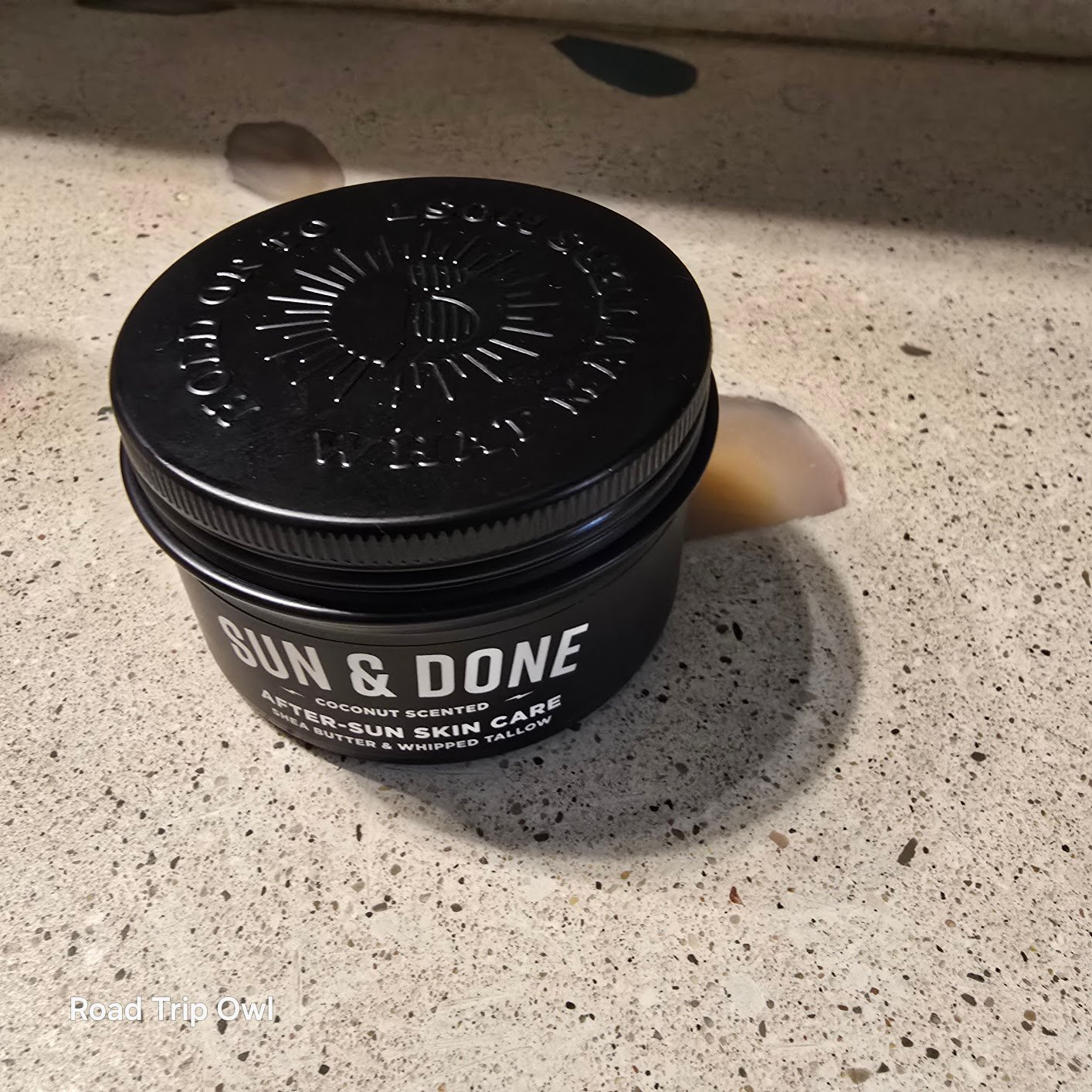
Pilotfish Sun & Done
This was the answer to my “wait, why am I using chemical after-sun if I’m using clean sunscreen” panic. I went looking, eventually found Pilotfish, and it’s the one I’ve been using ever since.
Why this one passes:
The ingredient list is what every clean after-sun product SHOULD look like and almost none of them do. It’s a body butter made with shea butter and whipped tallow — same skin-compatible animal fat that makes Sky and Sol work. Plus coconut oil. That’s basically it. No fragrance, no preservatives, no synthetic anything.
(If you’re new to the whole tallow-in-skincare thing: it sounds odd but it’s been used for centuries. It matches your skin’s own oils way better than vegetable-based lotions, which is why it absorbs cleanly and doesn’t break my sensitive face out.)
How it actually performs:
I work outside, every day, every season. For the first couple weeks of spring my skin gets some sun every single day. And the most surprising thing about this lotion is how often I DON’T have to apply it.
For context: Sun Bum after-sun (which I’ll talk about next) is amazing — but I’m reaching for that bottle every 15 to 20 minutes when I’m dealing with a burn. With Pilotfish, I’m applying it about every OTHER day. The feel of it lasts. It just sticks around on the skin and keeps doing its job.
The compliment test:
This is the part I didn’t expect: I actually got a compliment on how soft my skin was while using this. That has never happened before in my life. So whatever’s happening with the shea butter and tallow combo — it’s not just healing redness, it’s actually leaving my skin in better shape than it was before.
The honest caveat:
I haven’t tested it on a really bad sunburn yet — because I haven’t gotten one since I started using it. Whether that’s because the Pilotfish is keeping things from escalating or just lucky timing, I genuinely don’t know. Based on how it feels and how rarely I have to reapply, my guess is it’d handle a bad burn just fine. But I want to be honest: that’s a guess, not a tested fact. If/when I get a bad one, I’ll update this article.
My sensitive-face note:
I don’t normally use lotion — anything I put on my face breaks me out. Pilotfish doesn’t. That’s about as high a bar as I have for a product, and it cleared it.
If You Can’t Go Full Clean Yet: Sun Bum After-Sun
I want to be honest about something: I used Sun Bum after-sun for years before I switched to Pilotfish. And the truth is — it works. It’s not clean. But it works.
Sun Bum’s after-sun is what got me through every sunburn until I found Pilotfish. If I’m being completely honest, it actually does fix a bad sunburn maybe twice as fast as the pace your skin would heal on its own. The aloe-and-cooling combination is real.
The catch:
To get that fast-healing benefit, you’re reapplying every 15 to 20 minutes. You don’t strictly have to — it’ll still work if you apply it less often, just slower. But the more you put it on, the faster it works, and when you’re really burned, that speed is worth it. So yeah, I reached for it every 15 minutes.
The bigger catch is the ingredient list. It’s not the worst out there, but it’s not clean by my standards — preservatives, fragrances, and added stuff I now look at and think, “why am I rubbing this into already-damaged skin?”
Who this is honestly for:
If clean skincare isn’t on your radar yet, or you can’t get clean products where you live, or you’re just not ready to spend more on a sunburn product — Sun Bum after-sun works. It really does. I’m not going to pretend it doesn’t, because I used it for years and would buy it again before I’d buy nothing.
Think of it as a stepping stone. The clean version (Pilotfish) is where you eventually want to land. Sun Bum is a perfectly fine bridge to get you there.
For Bad Burns Only: Vitamin E Pills
Important reset before this section: the vitamin E pill trick is not a Pilotfish substitute. These solve different problems.
Pilotfish is for the everyday stuff — mild redness, normal after-sun care, the “I’m a little pink” days. It’s a lotion. You use it like a lotion. Easy.
Vitamin E pills are for when you’re actually BAD burned. Bright red, hurts to touch your shirt, miserable. Or — the scenario I think most people will relate to — you’re on vacation with three days left, you burned yourself on day two, and you want to be back on the beach pain-free instead of sitting inside healing.
That’s what the vitamin E pill trick is for. It’s the bad-burn move. And the story behind why I trust it is real.
The pan story:
Years ago, I boiled water in a stainless steel pan. Then — because I am a person who sometimes forgets that hot things stay hot — I picked it up bare-handed.
I burned the absolute hell out of my hands.
I ran them under cold water. I owned an aloe plant — like, an actual living aloe plant sitting on my counter. I ran past it. I went straight to the vitamin E pills.
I cut one open, drenched my hands in the oil, and left it on for about 20 minutes.
It never burned again. It never hurt after that.
We’re talking about a stainless steel pan with boiling water — factually as hot as a kitchen burn gets. And the vitamin E did what no aloe, no cream, no over-the-counter burn gel has ever done for me before or since: it stopped the pain and saved the skin.
How to actually do this:
- Take a vitamin E pill (the gel capsule kind).
- Cut it open with scissors or a pin.
- Squeeze the oil out onto your skin.
- Repeat until the burned area is fully covered.
- Leave it on. Don’t wipe it off. Let your skin drink it.
Honest about what it’s like:
I’m not going to pretend this is pleasant. The vitamin E oil is sticky. It’s thick. It feels weirder on your skin than any normal lotion. You’ll go through a few pills for any decent-sized burn. And cutting capsules open is annoying.
So why bother? Because when you’re really burned, speed of healing matters more than how the application feels. I’d rather feel a little sticky for 20 minutes and have my skin healed by morning than spend three days slowly recovering while a “more pleasant” cream does basically nothing.
For a little redness? Don’t bother. The Pilotfish lotion is plenty.
For a real burn? Cut open a pill. Trust the process. The sooner you use it, the better.
Took me four tries to find a vitamin E supplement that was actually natural. Most of the top-selling vitamin E on Amazon is the synthetic form — labeled dl-alpha tocopherol (note the “L”). The natural form is just d-alpha tocopherol (no “L”), usually derived from sunflower oil. For clean-skincare purposes, you want the natural form.
Why I keep them on hand:
You don’t plan to get really sunburned — that’s kind of the whole problem. So the vitamin E pills live in:
- My suitcase (every trip, no exception)
- My first aid drawer
- Probably three other random places around the house
They’re cheap, they don’t expire fast, and when you actually need them, the cost-to-benefit ratio is unreal.
I will forever have vitamin E pills in my suitcase.
(One honest note: for severely bad burns — blistering, large area, anything that really needs medical attention — please see a doctor. The vitamin E pill move is for bad sunburns and kitchen-mistake burns, not third-degree territory.)
A Note Before You Go: I Haven’t Tested 30 Products
You know how this article usually goes. “I tested 23 clean sunscreens over 6 weeks and here’s my ranking.” More products = more authority, apparently.
Here’s my version: I use two. They work. I stopped looking.
I know that sounds either suspicious or unimpressive depending on how you take it. But I want to be straight with you. I’m not a beauty blogger churning through products for affiliate revenue. I’m someone who works outside, has sensitive skin that breaks out at the slightest provocation, and spent years actively looking for clean sun care that worked. When my sister handed me Sky and Sol and when Pilotfish finally turned up after my own search, both of them solved my problem. So I stopped.
And honestly? I’m not someone who normally stops looking. I’m the one with seven tabs open at 11pm comparing brands. The fact that I stopped looking is kind of the whole review.
Now here’s the part I actually want to say out loud:
If you’ve been looking for clean sun care for years too — this is a celebration. Not just “cool product I found.” A real win. Anyone who’s spent hours reading ingredient labels, getting frustrated with “natural” brands that turn out to be greenwashed, giving up and going back to chemical sunscreen out of pure exhaustion — you know exactly what I’m talking about.
Finding one product that’s actually clean and actually works is a big deal. Finding two is worth celebrating. So if you’re here because you’ve been looking too — welcome. We found them. That matters.
Here’s my promise: if I ever find something cleaner, that works better, or that’s easier to use — I’ll update this article and tell you. That hasn’t happened yet. When it does, you’ll know.
In the meantime: these two are it. Plus vitamin E pills in your suitcase, just in case it gets bad.
That’s the whole clean sun care system. Simple, real, tested in real conditions on real skin.
Bonus Rabbit Hole: Tomato Paste Is Basically SPF 1.3
Quick aside on how deep my search for clean sunscreen actually went: at one point, I was reading scientific studies about whether you could eat your way to UV protection. (Yes, this is a real thing. No, I am not making this up.)
Here’s what I found:
Tomato paste is packed with lycopene, an antioxidant that — when consumed consistently — gets stored in your skin and provides some defense against UV damage. Studies show that eating around 4 to 5 tablespoons of tomato paste daily for 10 to 12 weeks can reduce skin reddening from UV by 25-35%.
The catch: that’s the equivalent of about SPF 1.3.
Yeah. 1.3.
So no, this is not replacing sunscreen. Not even a little. Five tablespoons of tomato paste a day for three straight months gets you the protection of standing slightly farther away from the sun. But it IS a fun thing to know — and the lycopene also boosts procollagen (helps with skin elasticity) and may reduce some UV-related cellular damage. So if you’re already a pizza-and-pasta person, you’re technically doing your skin a tiny favor.
Pro tip from the research: lycopene is way more bioavailable from cooked or processed tomatoes (paste, sauce, juice) than from fresh ones. And it absorbs better with healthy fats — so olive oil isn’t just delicious, it’s helping the math.
Tomato juice works too: about 1 cup gives you a similar lycopene dose to 5 tablespoons of paste.
So: eat your tomatoes. Don’t skip the sunscreen.
Frequently Asked Questions
What does “clean” actually mean to me?
It’s a fair question because the word “clean” is doing a lot of work in this article. For me, “clean” means:
- No synthetic UV filters (like Octinoxate, Oxybenzone, Avobenzone)
- No synthetic fragrances or preservatives
- No silicones, parabens, or PEGs
- Ingredients I could honestly eat without worrying
That last one is the bar I personally use. If the ingredients can’t be eaten, why am I putting them on the largest organ of my body? That’s the standard Sky and Sol and Pilotfish both meet.
Is mineral sunscreen as effective as chemical sunscreen?
For sun protection, yes. Mineral sunscreens (zinc oxide, titanium dioxide) actually start working immediately because they reflect UV instead of having to absorb and react. Chemical sunscreens need about 15-20 minutes to “activate” on your skin.
The trade-off is that mineral sunscreens can sometimes leave a white cast, especially on darker skin. Sky and Sol doesn’t, which is one of the reasons it works for me.
Why tallow in sunscreen? Isn’t that weird?
Tallow has been used in skincare for centuries — it’s only weird because modern marketing trained us to think only plant-based equals “natural.” But tallow matches your skin’s own natural oils way better than vegetable-based fats. That’s why it absorbs without feeling greasy, doesn’t break out sensitive skin, and doesn’t sit on top of your skin like a film.
Is Sky and Sol vegan?
No — Sky and Sol contains tallow (rendered beef fat). If you need a vegan clean sunscreen, this one isn’t for you. I don’t have a vegan clean sunscreen I personally use and would recommend, so I’d point you to other resources for that.
How often should I reapply Sky and Sol?
Standard sunscreen advice: every 2 hours, or immediately after swimming or heavy sweating. The “water-resistant for 80 minutes” claim is for water/sweat — the time-based reapplication still applies.
Can I use these on my face?
I use both Sky and Sol and Pilotfish on my face, and I have skin that breaks out at the slightest provocation. The vitamin E pill trick works on face burns too, but it’s sticky and oily — apply less than you would on your body, and consider doing it at night so you can rinse off in the morning.
That said, every face is different. If you’re prone to reactions, do a patch test on your inner arm first and wait 24 hours before going full-face.
What if I’m allergic to something in these?
Always patch test if you have any history of skin reactions. Put a small amount on the inside of your forearm and wait 24 hours. If you see any redness, itching, or irritation, don’t use it on your whole body. (Good advice for any new skincare product, clean or otherwise.)